The Shah’s Authoritarian Rule and Rising Discontent
Mohammad Reza Pahlavi’s rule over Iran, from 1941 to 1979, is widely regarded as authoritarian, characterized by the suppression of political dissent and the use of repressive tactics to maintain control. The regime’s reliance on the secret police, SAVAK, to silence opposition fostered a climate of fear and contributed to growing discontent among diverse social groups who felt marginalized and disenfranchised..
Economic inequality was a key driver of discontent. Although Iran possessed immense oil wealth, the gains from economic growth were unevenly shared, creating sharp divides between the affluent elite and the struggling masses. While the regime pursued rapid modernization—such as through the White Revolution, which promoted land reform and women’s rights—many Iranians were left behind, fueling widespread frustration, especially among lower- and middle-class citizens.
Additionally, the Shah’s aggressive westernization efforts sparked a backlash among conservative sectors of society, particularly among religious leaders and traditionalists. His regime’s alignment with Western influences, especially the United States, was viewed as undermining Iranian culture and Islamic values. This sentiment resonated strongly with influential clerics, who began to mobilize the populace against the Shah. Likewise, leftist groups and reformists saw an opportunity to exploit the widespread discontent, each advocating for varying degrees of social and political reform.
The amalgamation of these factors created a potent environment for dissent and disillusionment, setting the stage for the eventual uprising that would culminate in the Iranian Revolution of 1979. The dissatisfaction toward Pahlavi’s rule thus emerged not only from economic grievances but also from profound cultural and political concerns, ultimately leading to the revolutionary fervor that swept through the nation.
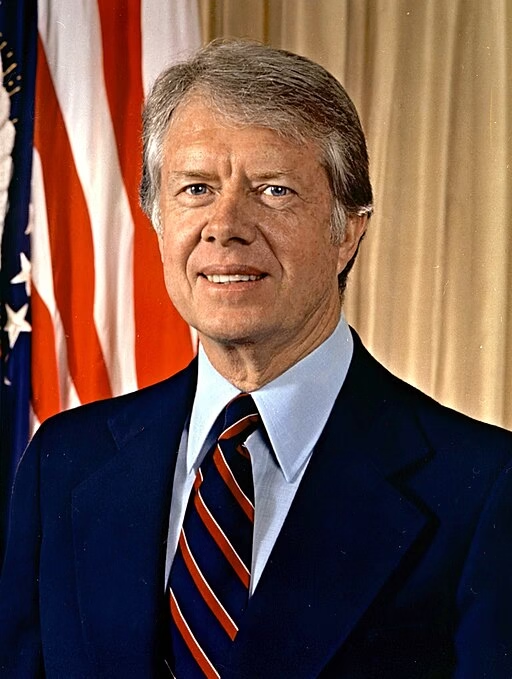
During the presidency of Jimmy Carter, which began in January 1977, a significant shift occurred in U.S. foreign policy towards authoritarian regimes, emphasizing the importance of human rights. This agenda was not merely a diplomatic nicety; it significantly influenced American relations with allies and adversaries alike. As part of this human rights initiative, Carter’s administration began to publicly address issues of civil liberties and political repression in various countries, including Iran under Shah Mohammad Reza Pahlavi.
Carter’s approach placed increasing pressure on the Shah to undertake political reforms and improve human rights conditions, which were seen as crucial for legitimizing his regime. However, this external demand for reforms was often perceived as an affront to the Shah’s authority and control. The Iranian monarchy had thrived on its autocratic rule, and the push for greater political openness posed a serious challenge to its legitimacy. Rather than strengthening his position, the Shah found himself caught in a precarious situation, facing growing domestic unrest fueled by the very reforms that Carter advocated.
This tension was exacerbated by the growing opposition movements within Iran, which coalesced around the call for greater civil liberties and political freedom. Groups opposing the Shah, including secular intellectuals and religious leaders, seized upon Carter’s human rights rhetoric to galvanize popular support against the regime. They argued that the regime’s incompetence and repression were unsustainable, leveraging the discourse on human rights to further their cause.
Consequently, while Carter aimed to foster a more humane and just international order, the ramifications of his human rights agenda in Iran may have inadvertently destabilized the Shah’s regime. The dual pressure of international expectations and domestic discontent created a revolutionary climate that contributed significantly to the eventual Iranian Revolution in 1979.
The Emergence of Ayatollah Khomeini and the Revolutionary Movement
Ayatollah Ruhollah Khomeini emerged as a pivotal figure in the opposition against the regime of Shah Mohammad Reza Pahlavi, rallying diverse factions under a cohesive Islamic revolutionary framework. Khomeini, originally a cleric with a significant following, utilized well-articulated critiques of the Shah’s regime to garner support from a variety of social classes, including the middle class, religious institutions, and the economically disenfranchised. His charisma and articulate opposition to Western influence, particularly perceiving it as a threat to Iran’s cultural identity, resonated deeply during a time of considerable national discontent.
The revolutionary movement orchestrated by Khomeini was characterized by its unification of disparate anti-Shah factions. These factions, which included leftists, nationalists, and religious groups, found common ground in their disdain for the Shah’s secular policies and perceived tyranny. Khomeini’s messaging, which framed the struggle as a moral and religious quest for justice, effectively galvanized collective mobilization across Iran. His ability to communicate the Islamic tenets of resistance helped solidify a national identity that opposed the existing regime.
As tensions escalated throughout the late 1970s, large-scale protests became a frequent occurrence in urban centers, with Khomeini’s calls for resistance igniting demonstrations that became emblematic of the broader revolutionary wave. The protests, marked by significant religious fervor, not only highlighted the regime’s inability to quell dissent but also demonstrated the strength of organized opposition led by Khomeini. His leadership was instrumental in transforming sporadic protests into a powerful movement, ultimately contributing to the revolutionary momentum that culminated in the overthrow of the Shah in 1979. The blending of political discontent with a strong religious narrative was unprecedented and remains a critical element in understanding the dynamics of the Iranian Revolution.
The Aftermath: The Islamic Republic and U.S.-Iran Relations
The Iranian Revolution of 1979 heralded a significant transformation in Iran’s political landscape, epitomized by the establishment of the Islamic Republic under the leadership of Ayatollah Ruhollah Khomeini. This profound change was not merely a shift in governance; it marked the emergence of a regime that fundamentally opposed the United States and its influence in the Middle East. The ideological rift between the newly formed government and the U.S. can be traced back to the regime’s perception of foreign intervention in Iran’s sovereignty, particularly the support the Shah received from the U.S. during his reign.
Following the revolution, U.S.-Iran relations deteriorated sharply, culminating in the Iran hostage crisis that began in November 1979. This crisis involved the seizure of the U.S. embassy in Tehran and the holding of American diplomats and citizens as hostages for 444 days. The event not only symbolized the deep-seated antagonism that had developed between the two nations but also had far-reaching implications for U.S. foreign policy in the region. The hostage situation severely affected American public opinion and led to a reevaluation of U.S. diplomatic strategies in the Middle East, as well as precipitating a long-standing policy of economic sanctions against Iran.
The perception of U.S. disengagement that emerged during this tumultuous period further exacerbated the geopolitical tensions. Iran’s leadership capitalized on anti-American sentiment to solidify power domestically, framing the U.S. as a principal adversary and source of instability. This antagonism established a paradigm that has characterized U.S.-Iran relations for decades. The aftermath of the revolution represents a complex interplay of historical grievances, ideological conflicts, and geopolitical maneuvering, which continues to influence the dynamics of the Middle East and international relations today.
Discover more from EAGLE HORIZON REPORT
Subscribe to get the latest posts sent to your email.